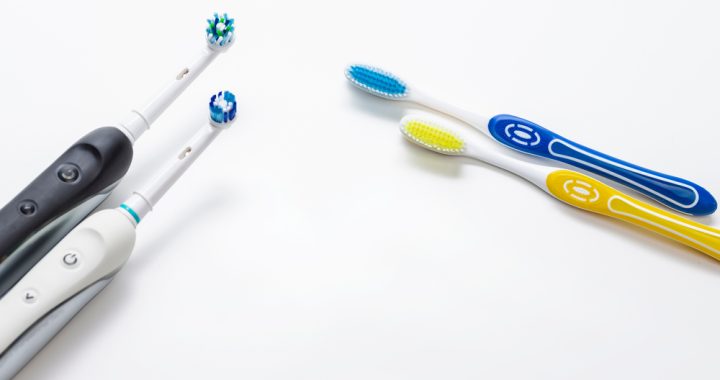
We all need a good toothbrush. There are several options, each with its advantages. But whichever brush we choose, the most important issue is making sure we use that toothbrush every day.
Conventional Manual Toothbrushes
Qualities to Look For:
When choosing a manual toothbrush, consider the following qualities:
- Soft Bristles: Soft bristles are recommended by dental professionals, as they effectively clean teeth while being gentle on gums. Previous generations used hard bristle toothbrushes, which were later shown to wear away tooth enamel and cause gum recession over time. Soft bristles cause little to no damage.
- Head Size: Many find that a toothbrush with a smaller head size allows easier access to all areas of the mouth, particularly the back molars. A toothbrush head that is around one inch long and half an inch wide is ideal for most adults. Children may want a smaller head on the brush to suit their smaller mouth.
- Bristle Pattern: The arrangement of bristles can vary, with some toothbrushes featuring crisscross patterns, wavy designs, or angled bristles. These variations are designed to enhance cleaning efficiency by targeting different areas of the teeth.
- Comfortable Handle: The handle should be comfortable to hold and allow for easy manoeuvrability. A non-slip grip can be especially beneficial for those with limited hand mobility.
Conventional Toothbrush Advantages:
- Affordability: Manual toothbrushes are inexpensive and widely available.
- Control: Users have full control over the brushing pressure and technique.
- Portability: Manual toothbrushes are lightweight and easy to carry, making them ideal for travel.
Electric Toothbrushes
Electric toothbrushes have a small electric motor that oscillates the bristle head. The first electric toothbrushes, in the 1970s, were often seen as little more than a gimmick. Often they just vibrated. But the designs have greatly improved since them. New toothbrushes are available in various models, offering different speeds and features. Most commonly they are recharged from the power point, though some require replacement batteries. Only the head of the brush is replaced when worn, while the body of the brush is kept for further use.
Working Principle:
Electric toothbrushes clean on the principle of mechanical movement. The motor moves the bristles which physical clean the teeth. It is the same principle as conventional toothbrushes, but the high speed movement means it is quicker and more thorough.
Electric Toothbrushes Advantages:
- Efficiency: Electric toothbrushes can deliver thousands of brush strokes per minute, significantly increasing cleaning efficiency.
- Ease of Use: People with hand coordination issues, the elderly or injured, find electric toothbrushes much easier to use.
- Motivation: They encourage children to brush, as children like the novelty factor.
- Built-in Timers: Many electric toothbrushes come with built-in timers to ensure that users brush for the recommended two minutes.
- Pressure Sensors: Some models have a pressure sensor, so users know if they are applying too much force. This protects the gums and enamel from damage.
Electric Toothbrushe Considerations:
Electric toothbrushes are initially more expensive than manual brushes and require regular charging or battery replacement. Yet, for many people, the enhanced cleaning efficiency justifies the cost. And as they tend to last for several years the cost is not that much higher in the long term.
Sonic Toothbrushes
Sonic toothbrushes are a type of electric toothbrush that operates at a much higher frequency, typically producing between 24,000 and 48,000 brush strokes per minute. These toothbrushes are designed to create rapid vibrations that enhance the cleaning process.
Sonic Toothbrushes Working Principle:
Sonic toothbrushes work by generating high-speed vibrations that create dynamic fluid action. This action drives fluid between the teeth and along the gumline, disrupting plaque even in hard-to-reach areas. Sonic toothbrushes operate at frequencies that are high enough to produce audible sound waves, which is where the term “sonic” comes from.
Sonic Electric Toothbrush Advantages:
- Superior Cleaning: The rapid vibrations of sonic toothbrushes provide an even better cleaning result than standard electric toothbrushes, reaching areas that bristles alone may miss.
- Improved Gum Health: The fluid dynamics created by sonic vibrations can help improve gum health by massaging the gums and promoting circulation.
- Plaque Removal: Sonic toothbrushes have been shown to remove more plaque than both manual and standard electric toothbrushes, particularly in areas like the gumline.
Sonic Toothbrush Considerations:
Sonic toothbrushes will be more expensive than standard electric toothbrushes, and like other electric models, they require regular charging. However, their ability to deliver a deeper clean can make them a worthwhile investment for those with specific dental needs.
Ultrasonic Toothbrushes
Ultrasonic toothbrushes represent the latest advancement in toothbrush technology. These toothbrushes operate at an even higher frequency than sonic models, using ultrasonic waves to clean teeth and gums.
Ultrasonic Toothbrushes Working Principle:
The cleaning principle of Ultrasonic toothbrushes is different to other electric toothbrushes. They produce vibrations at over 1 MHz, sometimes up to 3 MHz.
These ultrasonic waves break up plaque and bacteria at a microscopic level. This cleaning action extends beyond the area directly touched by the brush; even areas near the brush (perhaps half of a centimetre) will be cleaned by the ultrasonic vibrations. This means they can clean between the teeth and under the gumline.
Ultrasonic Toothbrushes Advantages :
- Plaque and Bacteria Removal: Ultrasonic toothbrushes are highly effective at disrupting plaque and bacterial colonies, even in areas that are difficult to reach with bristles alone.
- Gentle on Gums: Because ultrasonic toothbrushes rely on ultrasonic waves rather than mechanical movement, they can be gentler on gums, making them ideal for people with sensitive gums or periodontal issues.
- They clean under the gum, so they go a long way towards fighting gum infections.
- Efficiency: Ultrasonic toothbrushes can achieve a deep clean in a shorter amount of time, which is beneficial for those who may not be able to brush for the full two minutes.
Ultrasonic Toothbrushes Considerations:
Ultrasonic toothbrushes are the most expensive option on the market, and they require careful maintenance to ensure optimal performance. We will also need new brush heads from time to time. However, for those who are serious about oral health or who have specific dental concerns, the investment can be worthwhile.
Camden Dentists Advice on Toothbrushes
The best toothbrush is the one we use every day. Yet, there can be advantages to buying an electric, sonic or ultrasonic toothbrush. They can often clean efficiently and quickly. And if they encourage us to brush more frequently, then they are worth the extra cost. Talk to our Camden Dentists about your oral health.
Information Disclaimer
The content of this article is meant for informational purposes only and should not be considered a source of professional advice, recommendations, or endorsements. It is not a substitute for seeking expert guidance or making well-informed decisions based on individual circumstances. Although we strive for accuracy and reliability, we cannot guarantee the information's completeness or suitability for all situations. Readers are urged to verify facts, consult experts, and consider their own context before taking actions or decisions based on this content. No warranties, explicit or implied, are provided regarding the accuracy, timeliness, or completeness of the presented information. Relying on this information is at the reader's own discretion and risk. We encourage readers to consult relevant professionals or experts for advice tailored to their specific needs. Neither the author, publisher, nor any affiliated parties will be held responsible for errors, omissions, or damages resulting from the use or reliance on the information in this article.